Conflict Minerals Management
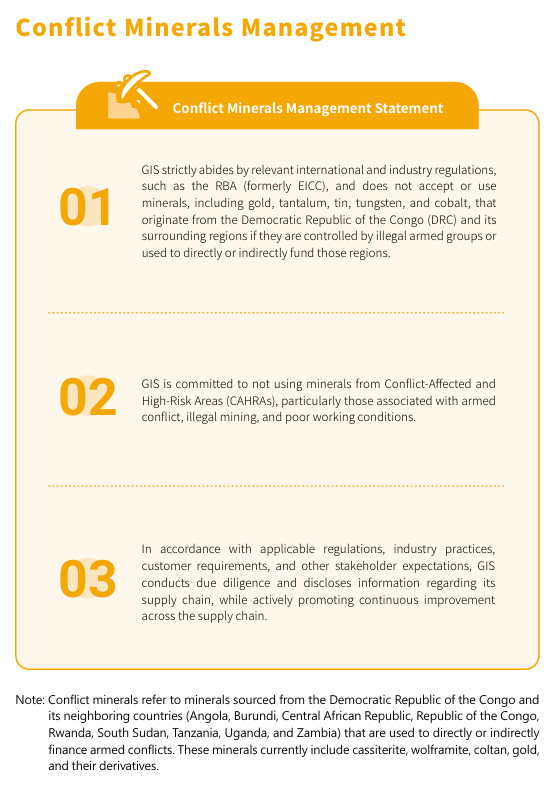
GIS strictly prohibits the use of raw materials containing conflict minerals for its products. In addition to establishing the Conflict Minerals Management Operating Regulations and the Supplier Management Operating Regulations, the Company also reviews and updates its relevant management practices regularly, with reference to client requirements, international standards, and industry trends. In recent years, due to labor human rights concerns related to the mining and processing of cobalt and mica, GIS has aligned with the Responsible Minerals Initiative (RMI) and included both cobalt and mica in its conflict minerals management scope.
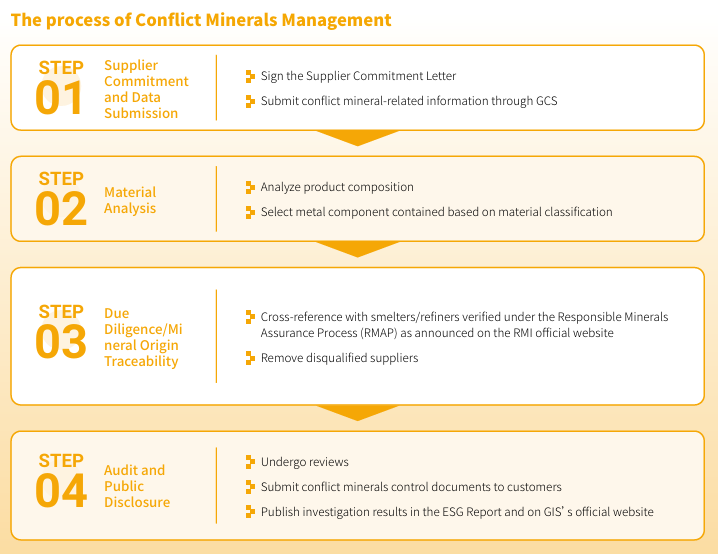
GIS requires suppliers not only to declare their commitment to avoiding the use of conflict minerals by signing a commitment letter, but also to complete the Conflict Minerals Reporting Template (CMRT) or Extended Minerals Reporting Template (EMRT) provided by the Company. In the event of regulatory updates or changes in end customer requirements, suppliers must comply with any new or revised requirements of the Company. To facilitate systematic management, GIS has also established an internal supplier profile system: the Green Component System (GCS). Before introducing any new material, suppliers must perform raw material traceability management in accordance with GIS’s Green Product Management Operating System, and only materials that pass the Company’s review may proceed to procurement.
GIS has removed all suppliers with doubts, achieving a 100% conflict-mineral-free supply chain.
GIS strictly observes international environmental laws. We formulated the Regulations Governing Controlled Substances in adherence to the principle of not using conflict minerals (3TG), incorporated banned conflict minerals into routine management, verified the source of materials used, and conducted yearly inventory on high-risk suppliers.
Conflict Minerals Risk Management
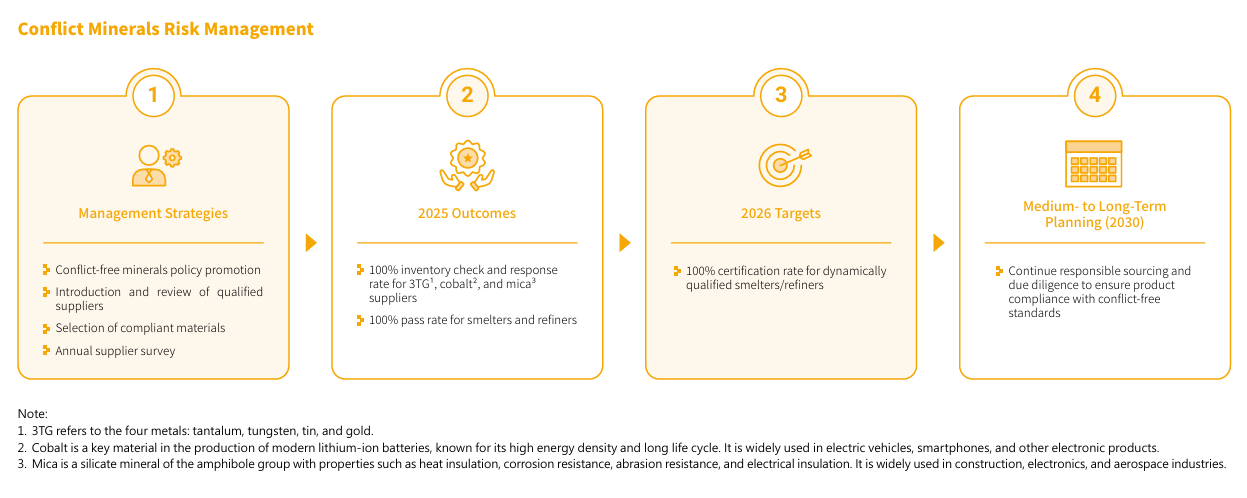
Each year, GIS conducts risk identification and establishes corresponding management approaches and targets based on the identified risks. The Company regularly reviews progress toward these targets, continuously promotes responsible sourcing practices, and carries out due diligence to ensure that its products comply with conflict-free sourcing requirements.
Supply Chain Due Diligence
GIS performs annual supply chain due diligence in accordance with the Due Diligence Guidance for Responsible Supply Chains of Minerals from Conflict - Affected and High-Risk Areas issued by Organization for Economic Cooperation and Development (OECD). The scope of the investigation extends beyond first-tier suppliers to include second-tier (or lower) suppliers. Using its internal Green Component System (GCS), GIS integrates real-time data from the RMI's list of third-party certified conformant smelters and critical material information, enabling ongoing monitoring and the prompt removal of non-compliant suppliers. This ensures that 100% of the minerals in GIS's supply chain are sourced from smelters certified by third-party assurance programs.
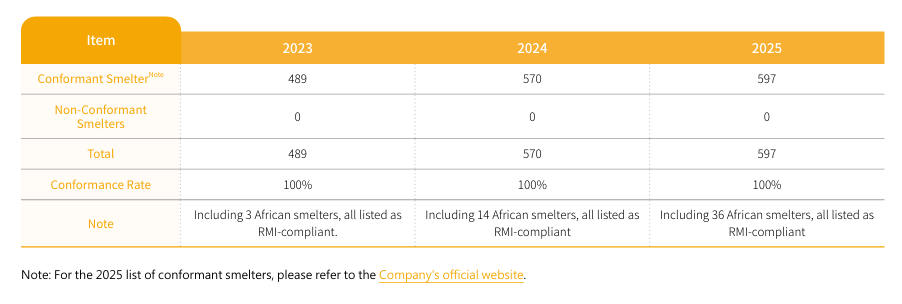
Supply Chain Due Diligence Results
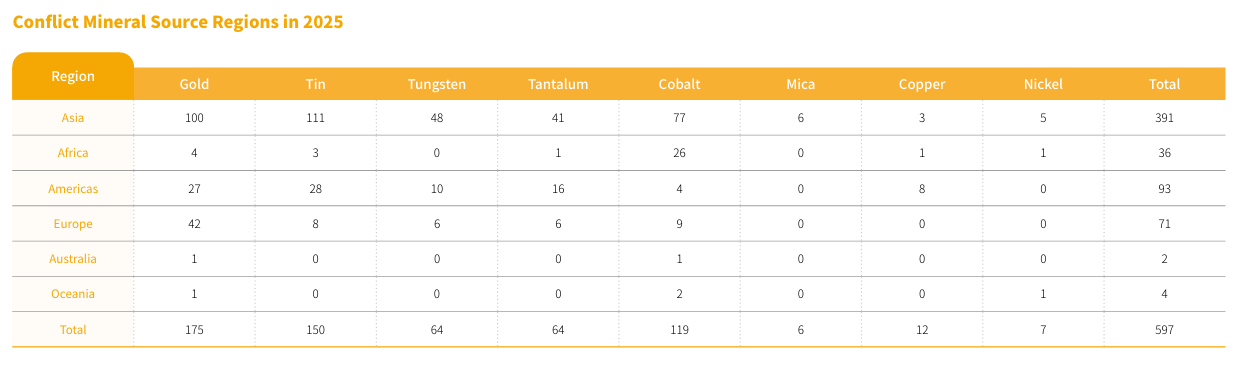
In 2025, due diligence was conducted on 102 suppliers with whom GIS has direct transactions, achieving a 100% response rate. The investigation covered a total of 597 smelters and refiners, including 36 located in Africa. Confirmed that a total of 597 are listed as RMI-compliant, achieving a 100% conflict mineral-free supply chain. The investigation results are summarized on the right: