Human Rights Management
Respect for human rights is one of GIS's core values. In the course of its various business operations, GIS adheres to the United Nations Universal Declaration of Human Rights, the United Nations Global Covenant, the United Nations Guiding Principles for Business and Human Rights, the International Labour Organization Declaration on Basic Principles and Powers, the OECD Code of Conduct for Multinational Corporations, the Global Sullivan Principles, the Corporate Sustainability Due Diligence Directive, and the laws and regulations of the places where it operates. GIS formulates and updates its human rights policies and takes actions consistent with the Code of Conduct of the Responsible Business Alliance on the basis of the principles of protection, respect, and remedy, demonstrating its emphasis on human rights issues.
GIS employees come from all over the world, and our company insists that every employee should be treated equally and with respect. We reference and follow international standards, integrate their spirit, and internalize them to develop our own "Corporate Social Responsibility Management Manual." Furthermore, we strengthen the protection of employees' rights through detailed regulations such as the "Regulations on Prohibition of Child Labor," "Regulations on Special Protection for Minors," "Regulations on Avoiding Forced Labor," and "Regulations on Anti-Discrimination."
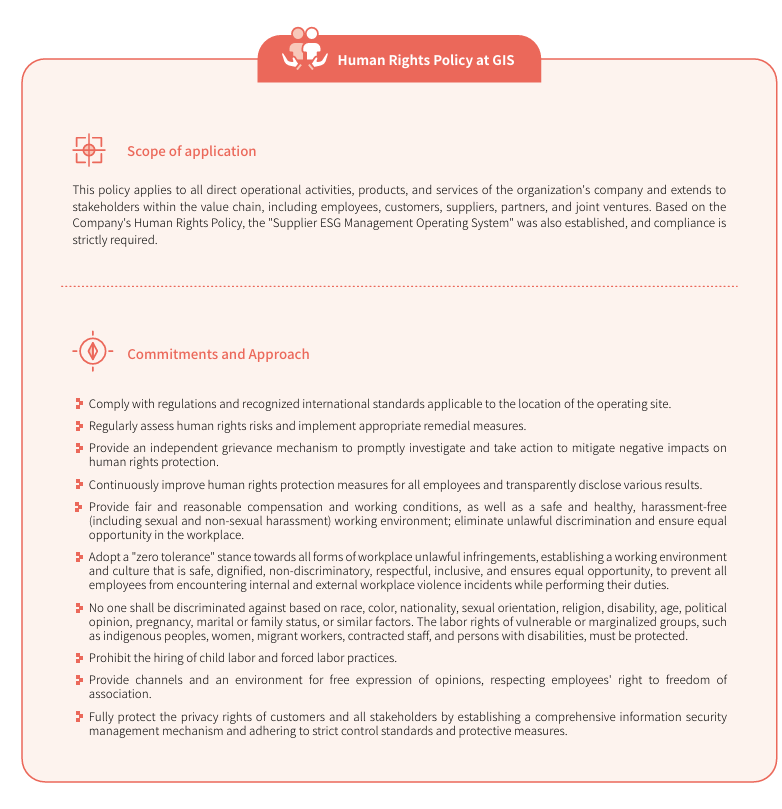
Scope of Application:
This policy applies to the direct operational activities, products, and services of all GIS enterprises and organizations, and extends to stakeholders in the value chain, including employees, customers, suppliers, partners, and joint ventures. Based on this GIS Human Rights Policy, the company also establishes a code of conduct for the supply chain and requires its strict adherence.
Commitments and Policies:
Comply with the laws and regulations of the operating locations and recognized international standards.
Regularly assess human rights risks and take appropriate remedial measures.
Provide an independent grievance mechanism, promptly investigate and take action to mitigate negative impacts on human rights protection.
Continuously improve human rights protection measures for all employees and transparently disclose all results.
Provide fair and reasonable compensation and working conditions, as well as a safe and healthy working environment.
Equal employment opportunities and treatment are guaranteed regardless of nationality, race, color, sexual orientation, ethnicity, age, gender, disability, pregnancy, religion, political affiliation, or marital status.
We firmly oppose any form of discrimination in recruitment, promotion, compensation, training, dismissal, or retirement, creating a diverse, inclusive, and harassment-free work environment and eliminating all forms of discrimination.
The employment of child labor and forced labor is prohibited.
Provide channels and an environment for free expression of opinions and respect employees' right to freedom of association.
We fully protect the privacy rights of our clients and all stakeholders, establish a sound information and communication security management mechanism, and adhere to rigorous control standards and protective measures.
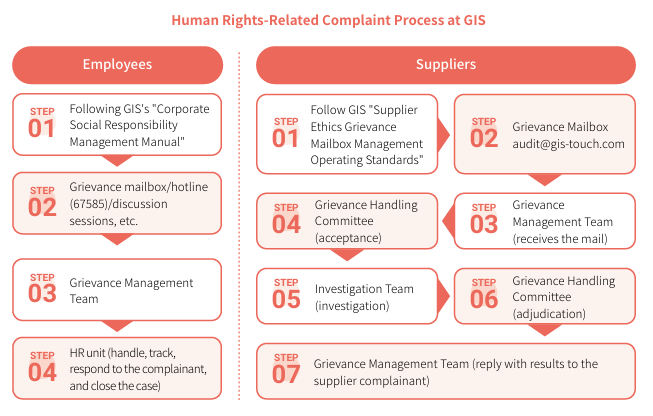
Complaint Channels:
Employees can file complaints/report human rights and equality issues through the company's Care Hotline at 67585.
GIS also provides a supplier complaint channel. If you discover any illegal activities, please contact us at audit@gis-touch.com
Human Rights Due Diligence
GIS has established a management system based on RBA (Real-Time Assessment Program). This system ensures that GIS policies and internal management meet relevant requirements through regular tracking of legal and regulatory updates and compliance, labor rights and business ethics risk assessments, KPI establishment and tracking, and management reviews.
In addition to regularly conducting RBA Verification Assessment Program (VAP) audits, our company also invites external experts to train GIS internal auditors and implements daily controls to continuously protect the basic human rights of our employees.
GIS's 2025 Labor Rights Risk Assessment included 32 items, covering employee training, recruitment, working hours, salary and benefits, employee relations, and others (such as freedom of association). The primary potential beneficiaries were our own employees and supplier employees. The assessment results were: 0 high-risk items, 2 medium-risk items, and 30 low-risk items. Since no high-risk items were identified, our company will re-examine the suitability of relevant documents, processes, and monitoring plans for the medium-risk items.
Remedial/Mitigation Measures
Low-risk projects → Continuous monitoring according to current management practices.
For example: No child labor incidents occurred in 2025 → If an investigation reveals misuse of child labor (such as identity theft,
use of false ID cards, etc., which went undetected during onboarding), the local Ministry of Labor should be notified immediately.
Remedial measures should be implemented in accordance with local laws, including arranging physical examinations.
With the assistance of the Ministry of Labor, the children should be returned to their place of origin and handed over to their parents or other guardians.If necessary, the company may provide appropriate financial assistance to help them complete their compulsory education.
Medium-risk projects → Work time management (overtime, continuous attendance). The company has implemented work time management and early warning mechanisms after internal review.
*In accordance with the "Labour Human Rights and Business Ethics Risk Assessment Operating Procedures", GIS conducts a systematic assessment of the company's potential human rights risks on an annual basis. For details, please refer to the 2025 Sustainability Report.
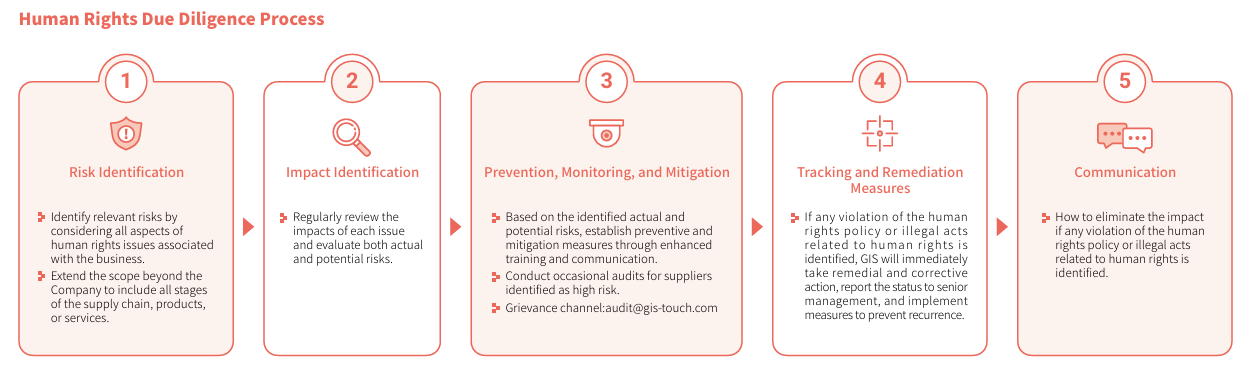
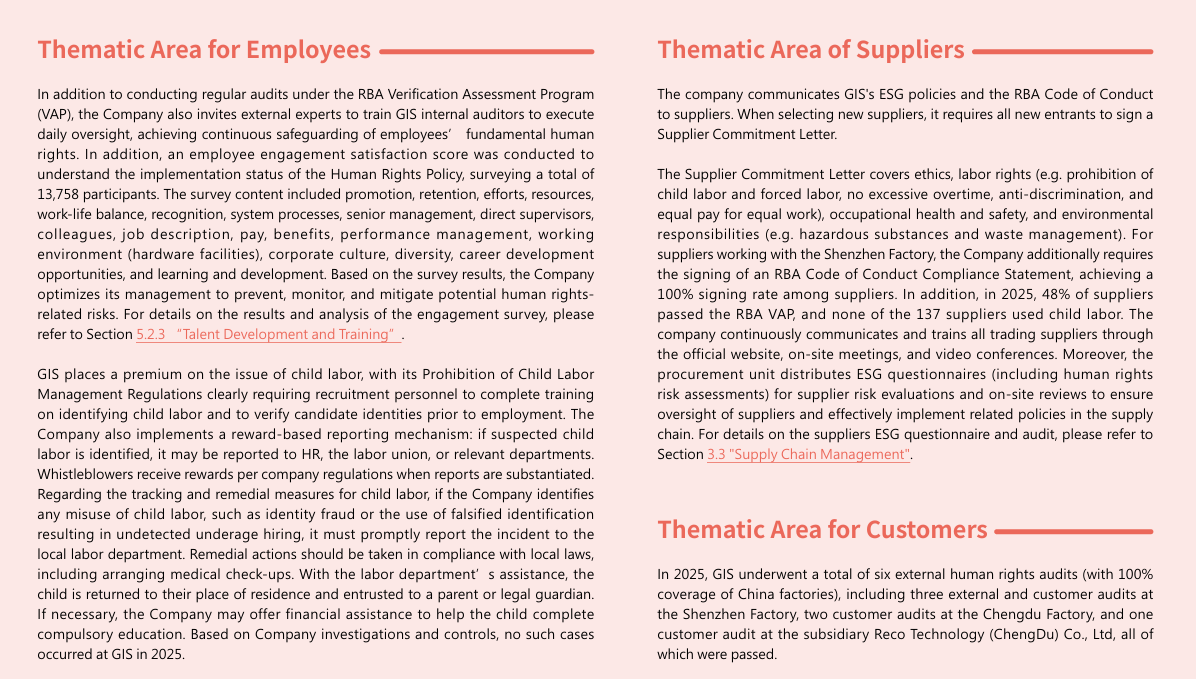
In addition to conducting human rights due diligence, GIS employs various forms to support the Prevention, Monitoring, and Mitigation of human rights-related risks for key Stakeholders— Employees, Suppliers, and Customers, and actively identifies any potential overlooked human rights-related risks.
GIS Human Rights Training
To strengthen employees' human rights awareness, GIS regularly conducts "corporate social responsibility" education and training. New employees receive orientation courses on corporate social responsibility and human rights topics, covering content such as an introduction to "corporate social responsibility, the "corporate social responsibility policy," and an introduction to the RBA. For new employee training, there were a total of 39,628 participants, accumulating 55,486 training hours. Regular human rights knowledge-enhancement training is also provided for current employees, with on-the-job training totaling 14,465 participants and 12,540 training hours.
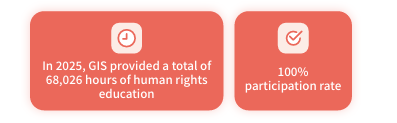
In 2025, the total number of participants in human rights training was 54,093, with a total of 68,026 training hours, and a participation rate of 100%.